On 3 February 2026, Fight the Fakes Alliance delivered a statement on agenda item 12: Substandard and falsified medical products at the 158th session of the WHO Executive Board in Geneva. The statement is provided below:
“Distinguished Delegates,
The International Alliance of Patients’ Organizations, on behalf of the Fight the Fakes Alliance, welcomes the 2025 discussions on the future of the Member State Mechanism on Substandard and Falsified Medical Products, including the recommendations arising from its evaluation under EB156.
We welcome the Mechanism’s proposal to adopt recommendation 1, Option B, and emphasise the importance of strengthening the involvement of technical experts and people with lived experience in its working groups. The inclusion of non-State actors brings specialised expertise, operational insight, and credibility, strengthening global efforts against SFMPs.
We reiterate our call for WHO to continue its work in this area and reaffirm our readiness to support and engage with the Mechanism and its members.
Thank you.”
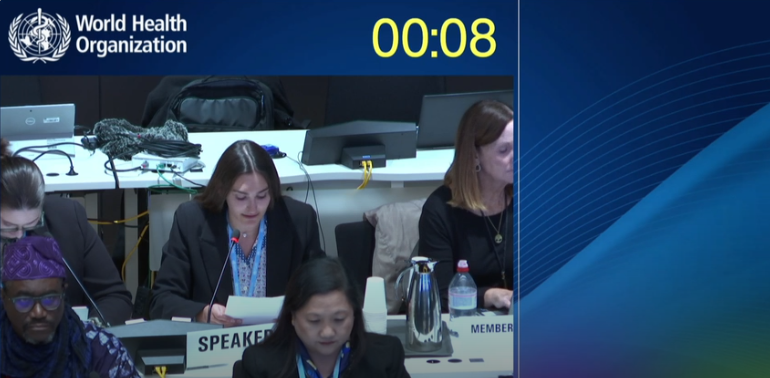
Photo: Sophie Robert, Fight the Fakes Alliance Secretariat, provided Fight the Fakes Alliance’s statement on agenda item 12: Substandard and falsified medical products, at the 158th session of the WHO Executive Board in Geneva on 3 February 2026.
Statements by other non-state actors included:
International Federation of Medical Students’ Associations
“Esteemed delegates and Honorable Chairperson,
On behalf of medical students and young health professionals worldwide, IFMSA expresses concern regarding the threat posed by substandard and falsified medical products. These products not only jeopardise patient safety but also compromise treatment effectiveness and worsen antimicrobial resistance, particularly in LMICs, where regulatory procedures and supply chain oversight may lack.
Tackling this challenge requires robust regulatory systems, quality assurance protocols, and comprehensive pharmacovigilance mechanisms. It is imperative that equitable access to safe medicines is prioritised.
We further highlight the role of youth and young physicians in combating this global issue. Through health education and meaningful advocacy, medical students can raise awareness about the dangers, support safe prescribing practices, and contribute to national pharmacovigilance initiatives.
Thank you.”
International Pharmaceutical Federation
“Distinguished Chair, honourable Members of the Executive Board,
I speak on behalf of the International Pharmaceutical Federation, representing over 5.5 million pharmacists, educators and pharmaceutical scientists worldwide.
FIP commends WHO and Member States for their continued commitment to protecting patients from fake medicines. We particularly welcome WHO’s 2025 Training Toolkit on Substandard and Falsified Medical Products, which aims to equip health professionals with skills needed to prevent, detect and respond to such products.
This initiative complements FIP’s longstanding work, including our curriculum for pharmacy students on fake medicines and our recently developed teaching modules on the risks of fake products online. Together, these tools build capacity for pharmacists to safeguard medicine quality.
As WHO advances its 2026–2027 priorities for the Mechanism, FIP looks forward to our continued collaboration.
Thank you.”
Read FIP’s full statement here: https://www.fip.org/file/6474
Union for International Cancer Control
“We welcome the report and commend the progress. Substandard and falsified medical products continue to threaten public health, especially for cancer patients. Several widely used cancer medicines have been found to fall short of essential quality assessments.
We urge Member States to:
* Support sustainable financing for the implementation of the Member State mechanism on substandard and falsified medical products
* Strengthen national regulatory authorities, including laboratory capacity and risk-based market surveillance, including tools like Epione, alongside improved data sharing with the Global Surveillance and Monitoring System to improve reporting and reduce duplication
* Prioritise strong communication strategies and drive coordinated cross-sector action against online and informal market distribution
* Reinforce supply chain oversight and data sharing, including high-risk raw materials.”