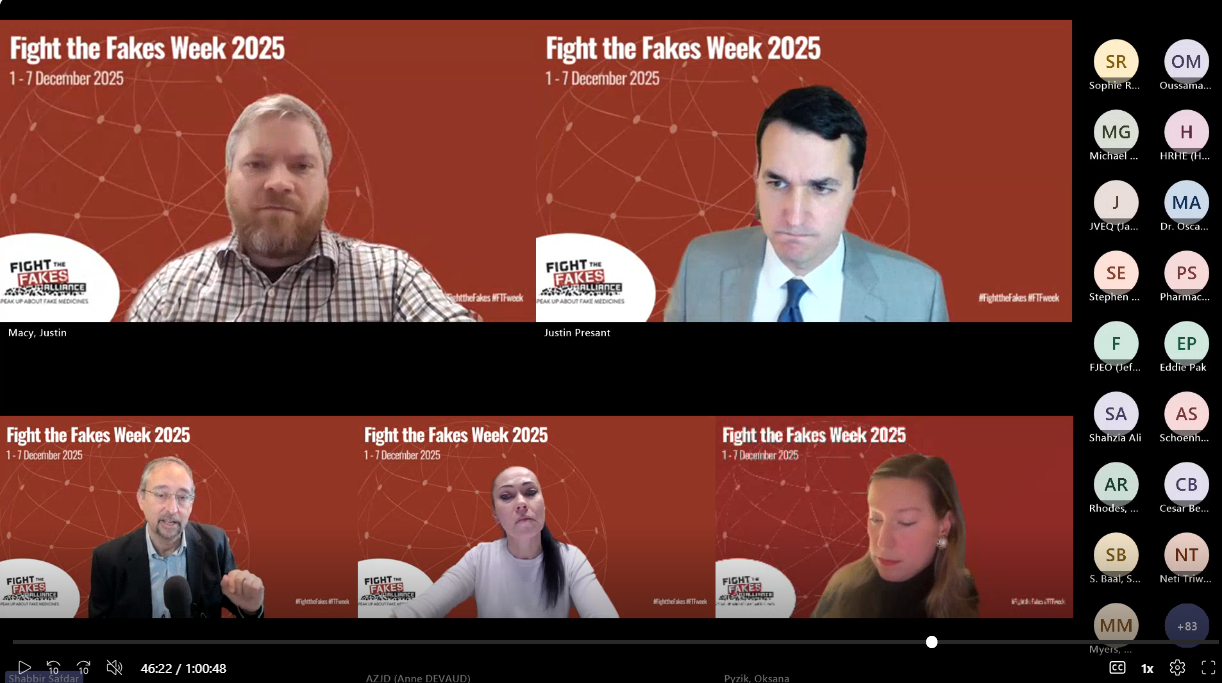
On 5 December 2025, the Fight the Fakes Alliance hosted a webinar, “Deadly Deceptions: The Rise of Falsified Weight Loss Medications and How to Fight Back,” which featured a diverse group of speakers, including:
- Shabbir Imber Safdar, Executive Director, Partnership for Safe Medicines (moderator)
- Prof. Oksana Pyzik, Associate Professor, UCL School of Pharmacy; Academic Chair of Fight the Fakes Alliance
- Anne Devaud, Global Product Security Head, Novo Nordisk
- Justin Macy, Director of Innovation, National Association of Boards of Pharmacy (NABP)
- Justin Presant, AVP, Assistant General Counsel, Special Investigations, Eli Lilly
Our panelists highlighted the fact that while these groundbreaking weight loss therapies are transforming care for millions of patients, they are also fueling a parallel surge in illegal supply chains, falsified medicines, misleading advertising, and unsafe prescribing pathways. Critically, the patient-safety challenges we see today around GLP-1 medicines will not fade. They will multiply.
“Ten thousand is probably an underestimate of the number of non‑compliant weight‑loss ads flagged by the UK Advertising Standards Authority in just five months of 2025—and that figure will only rise as unprecedented demand for GLP‑1s collides with the speed and reach of social media.” – Prof. Oksana Pyzik
As our panelists remind us, these falsified products are sold through social media, illicit online pharmacies, and increasingly through non-traditional healthcare settings such as med spas. Patients are becoming the first victims of a rapidly expanding criminal industry estimated to be worth more than $200 billion globally.
These falsified products aren’t just limited to online sales. However, as they products become more sophisticated, regulators and pharmaceutical companies are finding ways to distinguish genuine and falsified products:
“It’s not just online – we’ve actually found illegitimate GLP‑1 products inside US pharmacies. We built a system so any pharmacy or regulator can scan the data‑matrix code on a pack and immediately see whether the identifiers are genuine and whether the manufacturer has flagged that serial number in an investigation.” – Justin Macy
One encouraging message was shared by several panelists: there are already many laws and safeguards in place to help pharmacists and patients ensure they are accessing true medications.
“The vast majority of the patient‑endangering behavior we’re seeing with these knock‑off GLP‑1 products is already illegal in most jurisdictions. In the US alone, selling them can violate multiple criminal and civil laws – from Food, Drug and Cosmetic Act offences to smuggling and other forms of fraud.” – Justin Presant
As the panelists emphasized, the GLP-1 revolution has the potential to reshape public health for generations. But without strong safeguards, it also risks high levels of exploitation.
“Counterfeiting is a silent crime, and we need to speak out about it. Raising public awareness – including working with influencers – is essential, because above all this is a matter of patient safety.” – Anne Devaud
Patients, healthcare professionals, regulators, technology platforms, and pharmaceutical companies must work together to protect safe prescribing pathways, uphold clinical standards, and shut down criminal supply chains.
As our alliance and partners across the Fight the Fakes movement continue to emphasize: patients deserve medicines that are safe, effective, and real. Anything less is unacceptable.
You can find the recorded webinar on YouTube here: https://www.youtube.com/watch?v=7Z4F60_ts3g